Wednesday, October 2, 2013

Every New Encounter

Abraham Kabazie '15 composing
his blog post.
Our third day on the Blackfeet reservation has finally come and it feels as if the group has just arrived. The endless fields, larger-than-life sky, and the frigid wind made the biggest impressions on my first experience in Montana. As I started to dwell on these first encounters on our way back from the vistas of the revered buffalo jump, the first thought that came to mind was: "How can there be such poverty in such a beautiful place?" This question still continues to manifest with every new encounter I have in Browning.

I kept this question in mind as we walked a couple of blocks to Medicine Bear, the local shelter that feeds and gives care to anybody who stumbles in the door. The other immersion students and I served lunch and sat with the people. As the morning proceeded, almost every preconceived notion we had of this impoverished community was challenged by this new encounter. The context of the conversations I had ranged from sports to government conspiracy theories, but these discussions always included something about the Blackfeet reservation, whether it be the landscape or the hardships that the community faces everyday. The visitors of Medicine Bear told us of the helplessness they feel when confronted by this seemingly endless trend of distress. These claims were reinforced by the presentation we heard from Harry Barnes, a local business owner, who explained the challenges of reservation economics and clearly put into historical context the tough spot in which the Blackfeet are forced to live. Blame is often assigned to the federal government, who had, in history, taken action to control and limit the power of all Native Americans. These events are still fresh in the minds of the Blackfeet and are always the underlying context of a discussion on the state of the reservation.

Though I still have a couple more days to discover an answer to my question, I continue to hold on to my positive experience with the students at De La Salle Blackfeet School and take in the word-illusive (description-defying; mind-boggling; breathtaking; eye-pleasing) landscape that we observe everyday on our ride to and from the school as well as the "born free" aura that is sensed at the Holy Family mission.

Abraham Kabazie '15

P.S. Hi Mrs. Graffia! I'm so glad you're back!

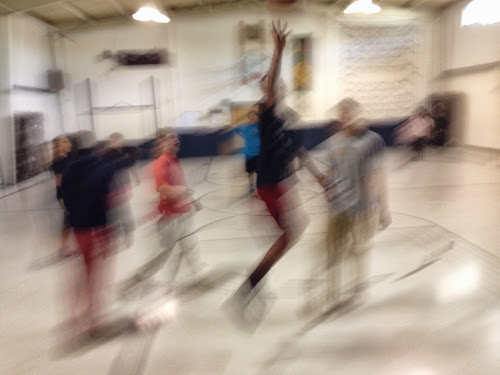
The dizzying pace of pick-up basketball

A Positive Attitude

It is hard to believe that after two-and-a-half days, we already are halfway through our immersion experience at De La Salle Blackfeet. It's really been a great, eye-opening experience. All of the children seem to be really nice. They have taken to us pretty well and are excited to have guests in their school. I've truly enjoyed being able to learn with them, and I feel as if I have established meaningful connections with them. Despite some of the challenges that exist on the reservation, I am impressed to see the children come into the school every day with a positive attitude, and I think we should all model this positive attitude in our own lives.

There have been a couple exceptional events over the past three days, starting with our experience of the scenery every morning on the bus ride to school. There's a good reason that Montana is called "Big Sky Country" - just look up and see how big the sky appears. The mountains, hills, and flat plains altogether create a picturesque and dreamlike landscape. I'm not sure if I've ever seen more beautiful lands in person, and words cannot describe everything that I've seen, from the mountains of Glacier Park to our experience on the Buffalo Jumps.
Also equally eye-opening was my trip to the Medicine Bear shelter yesterday morning. I was able to serve a hot meal to some of the local homeless and sit with them, listening and making conversation. The atmosphere was very welcoming, and the woman who runs the shelter even gave our group of immersion students a meal to enjoy as their guests. All of the residents were incredibly nice to us and seemed to carry that same positive attitude with them, despite the troubles that they face. We talked to these people for almost two hours, and they were happy to open up and talk to us about themselves and about their lives. It was a moving and eye-opening experience that I'll never forget.

I look forward to the rest of the week at De La Salle Blackfeet School, and I can't wait to share my experiences when I return to Pittsburgh.

Matthew Wisneski ’15


Investing in the Local Economy

After a long weekend of traveling and interesting first day of getting to know the students and the landscape of Montana, we finally got to hear from our first speaker. Harry Barnes, a successful local business owner, chairman of the DLSBS school board, and respected Blackfeet elder, gave us some expert insight on the history of the Blackfeet tribe, how tribal government works and how tribal spending effects the economics of the reservation.
Harry Barnes addresses our immersion group
The history of the Native Americans is one that is rich in culture and spirituality, but, at the same time, is also filled with tragedy and despair. The Indian Wars on the Great Plains with battles such as The Battle of Little Big Horn eventually lead to the Native Americans signing treaties and losing their land to the "white man." By being placed on reservations, the time honored tradition of self-sufficiency was disrupted. Ever since, Native Americans have faced many financial and social problems. Although complying with applicable state and federal law, the Blackfeet reservation has its own tribal laws and government that the people on the reservation must follow. The tribal government is headed up by the Blackfeet Tribal Business Council, which pretty much have final say in all Blackfeet reservation affairs.

Governments, at the local, state or federal level, have enormous power when it comes to purchasing. Instead of investing in local, Native-owned businesses like his that could create local jobs, the tribal government purchases goods such as office supplies and janitorial supplies from vendors not located on the reservation. Another idea Harry proffered was to open up a local oil change business which would be the exclusive vendor for the tribal government's fleet of 600 vehicles. By investing in these locally owned businesses, local jobs could be created and wages earned would be spent locally as well. More importantly, employment promotes a sense of self-worth that poverty diminishes. These examples of purchasing decisions have the potential to reinvigorate the local economy and community if the tribal council chooses to set the example.

Sam Heaps '15

Like the Dewfall

We are often reminded of the presence of the spirit in our Catholic faith. During Mass each week, we respond to the priests greeting "The Lord be with you" with "And with your spirit". The cornerstone of Eucharistic Prayer II, my personal favorite, asks God to make the gifts of bread and wine holy by "sending down his spirit upon them like the dewfall".

Just like the dewfall, God has certainly sent his spirit upon the students, teachers, and immersion participants at the De La Salle Blackfeet School. Saint John Baptist De La Salle once said, "To touch a students heart is the greatest miracle that a teacher can perform," (Med 139.3 - Feast of St. Peter) and that is exactly the situation here. After two days observing and helping the students in fourth grade, my partner Patrick Connolly and I observed the close relationship the students share with their teachers. While we all have our shortcomings at times, the students generally respond to their teachers' questions and instructions with respect, diligence, and thoroughness. The admiration that the children have for their teachers is also very clear through our discussions with them,showing that their hearts have been touched by their work and presence.

I also noticed the presence of the spirit in our interaction with the children during class and at lunch. On Monday, they were clearly shy and nervous about having an immersion group visit them. Because De La Salle Blackeet School begins enrollment at fourth grade, these children have never experienced a visiting immersion group before. By the end of the day, after we had an interactive Q/A session, they were eagerly asking us if we would return the next day. Our presence in their lives quickly touched their hearts, presenting them with positive role models and caring mentors during the week.

The Holy Spirit is with us this week at the De La Salle Blackfeet School and is helping us do our part in the immersion experience. Our work so far seems to be paying off - the children enjoy us helping them and the teachers appreciate our assistance during their lessons and activities. I am grateful that I was inspired by the spirit to journey to Browning, so far from home and my comfort zone, to take part in this rewarding experience. The Lord sent down his Spirit upon all of us, just like the dewfall.

Joseph Rogers '14

Tuesday, October 1, 2013

New Perspectives

Climbing: It took some effort to hike up there…
Montana has provided us with a change in scenery. While Pittsburgh is pretty nice and fairly scenic this time of the year, nothing beats the rolling Montana hills with snow-covered mountains towering over the landscape in the distance. It all sounds pretty perfect and picture-esque, but there are a lot of hardships on the reservation. As another immersion participant, Abraham, questioned, "how can a place so beautiful have such poor living conditions?" I think that seeing this stark contrast to the way we live has given us all a better sense of perspective.


...But the view sure did pay off
While the living conditions are often difficult, the De La Salle Blackfeet school serves as somewhat of a silver lining on the reservation for children that might not otherwise have much opportunity in their future. Brother Ray, the DLSBS immersion coordinator, says that two graduates of the DLSBS have even gone on to attend Stanford. Just being here the past two days, I've witnessed the connection that the students have with each other and the self-sacrifice that all the teachers have for their students. It's really incredible the things that this school is able to provide for the Blackfeet children.

My partner Joe and I have been assigned to fourth grade, and while it was a little uncomfortable yesterday when we first got here, the students quickly got to know us, and they really enjoy having us here just as we enjoy spending time with them. I got to work one-on-one with a few different students yesterday, and later on we had a Q+A session in which the students asked us questions ranging from, "what's your heritage?" to "what's your favorite food?" The DLSBS has grades 4-8, and since we're the first immersion group here this school year, the fourth graders had never experienced having an immersion group in the school before and were especially curious.

Aside from spending time in the school, all of us in the immersion group have spent some time getting to know each other and talking about how this trip has affected each of us so far. We've also had a few opportunities to explore the land. On Sunday, we hiked up the steep hillside beneath some cliffs known as the "buffalo jump," because it was off those cliffs that the Blackfeet Indians herded buffalo. The view from the top was breathtaking, and although I got some good pictures, those certainly don't do the landscape justice. Last night, Brother Ray drove us out to the "edge of the middle of nowhere," a very remote area where we could see millions of stars.


Overall, our time here thus far has been good and very eye-opening. Throughout the rest of the week, I look forward to getting to know the fourth grade students better and continuing to gain new perspectives into their lives and my own.

Patrick Connolly '14


Monday, September 30, 2013

From East to West

To my friends and family in Pittsburgh, my classmates at Central Catholic, and my colleagues at Our Lady of Loreto Church:

Upon our arrival in Browning, Montana yesterday, I couldn't help recalling the lines of Eucharistic Prayer III prior to the revision of the Roman Missal. The text read "From east to west, a perfect offering can be made." While I am clearly taking a literal approach to this spiritual text, I believe that it accurately describes our work and the mission of the Brothers of the Christian Schools.

We arrived in Browning yesterday after a long day of traveling. Brother Ray picked us up from the train station and drove us to De La Salle Blackfeet School, our workplace for the next week. Immediately upon entering the school, I noticed that the spirit of our patron saint, Saint John Baptist De La Salle, was present through pictures, symbols, and quotes along the walls. Each room contained a crucifix, the school's logo, and the prayer of the Brothers, "Live Jesus in our hearts, Forever!", the same words we recite daily at Central Catholic High School and every Thursday in my CCD class.

I was pleasantly surprised to see a strong Catholic identity in the schools atmosphere, making it a welcoming environment to for me to enter and work. My positive first impression was reinforced this morning at the morning assembly, when a young girl ecstatically announced to her friends that an immersion group is here, making us feel even more welcome. I personally felt at home when each student recited the morning prayer, and concluded with the words I am so used to. I realized that from East to West, we are all called to do the same work, to live positive and fruitful lives on Earth, and to always remember that we are in the holy presence of God, regardless of our ancestry, state, or timezone.

While my week at De La Salle Blackfeet School has only begun, I believe that our immersion group will have a positive experience working with children who need role models in their lives. My worries about this trip were quickly quelled, and I am very confident about my work this week, knowing that from East to West a perfect offering can be made to God through our work and experiences. Live Jesus in our hearts, forever!


Joseph Rogers '14


Planes, Trains, and Automobiles

By Mike Gibbons '14
Mike Gibbons (left) tutoring a student
in reading
Although the means of reaching our destination seem dreadful (2 planes, a train and a bus), they all came with some awesome experiences. After we made our way into our tight little seats in our congested United Airlines express jet for our flight from Pittsburgh to Denver,  an older woman reached up into the overhead stow away space and grabbed what seemed like a welcoming pillow and began cuddling it before we even took to the air. We all began to laugh under our breath as we realized that the lady didn't reach for a complimentary comfort device, she was actually cuddling poor James Stupar's pillow. While James writhed in emotional pain of not having his precious headrest, we cracked jokes and made friends with our two flight attendants, Shannon and Belinda. We landed in Denver and hopped onto our second flight to Spokane. After a three and a half hour plane ride to Denver, an two and a half hour long flight to Spokane, and a ten hour train ride to East Glacier, Montana, I've had enough of traveling. The flight to Spokane was less interesting as it was night now and everyone was planning on sleeping. Once we landed in the tiny airport in Washington, we learned we had a couple of hours before our taxis were to come and take us to the train station. To pass the time we explored the lifeless airport and found nothing of interest. In an attempt to keep us entertained, I made up a makeshift hacky-sack out of a pair of socks and some duct tape. It worked at first but not many of us were pros so we set up goals from the empty rocking chairs that lined the halls and played the most intense game of pick up soccer I've played in my life. Time came to catch our cabs and roll on over to the station at which I can now say I've slept on the floor. We caught our train really late at night and headed to Montana. I woke up and headed to breakfast in the dining car with Mr. Sudnik, Bill, and James. We had a good chat, and enjoyed our food and then headed back to the coach.

As we rolled along toward East Glacier, my eyes stayed glued to the beautiful views of Montana's wilderness.
The Two Medicine River as we approached
East Glacier, MT.

The closer we came to our stop the more infatuated I became with the geographical layout of the area, and the more ready I became to participate in this trip. We came to our stop in East Glacier and met Brother Ray, who was waiting for us with a smile on his face.
The East Glacier Train Station
We loaded up the bus and Bro. Ray acquainted us with the reservation. This weekend has been amusingly eventful and was a great way to warm me up to the work I'll be doing with the students of the De La Salle Blackfeet School.   After a three and a half hour plane ride to Denver, a two and a half hour long flight to Spokane, and a ten hour train ride to East Glacier, Montana, I had enough traveling.  However, now that we've arrived, I cannot wait to see what this Immersion Trip has in store for all of us.
Members of the tribal buffalo herd


Friday, September 27, 2013

The New Recruits

Joe Rogers

James Stupar

Bill Butterfield

Matthew Wisneski

Michael Gibbons

Nick Walnoha

John Wolfe

Abraham Kabazie

Patrick Connolly

Sam Heaps

Monday, October 8, 2012

Saying Goodbye to Browning...And Hello To Glacier National Park

Jack and Jill
After spending a week at DLSBS, we as had a group recreation day to wind down at Glacier National Park. Before this could begin, we had a few housekeeping matters to take care of; we had to clean the bunk house and pack our belongings. We said goodbye to our canine companions - Jack, Jill and the puppies we affectionately named after the Brothers at Central - and boarded the bus. There was a sense of sadness as we left the mission property because of all memories we made in our week together that will stay with us for a long time. As we made the drive from Browning to Glacier National Park, we saw scenic views of the Rocky Mountains, but these views could not be compared to what lay ahead.

The Ascent
As we arrived at the park, we disembarked the bus and saw Two Medicine Lake which sits quaintly between mountains that had a faint purple glow and rose up to the clouds. We ate our lunch with the lake as our scenic backdrop before heading out to the hiking trail. As we walked through the snow-capped pines, we got an aerial view of the lake that was glistening from the sun's rays. We soon found a scenic waterfall staring at us and we had an awesome time climbing it and taking in the view from the top. Once we reached the plateau of our climb, we had a few moments to reflect on the trip and tell stories about the week. We discussed the bonds we formed, and, most importantly, the lives we touched. As we trekked down the mountain, we started a large snowball fight amongst ourselves and it soon became a war. The curves on the trails gave us the advantage of surprise and you never knew who was going to strike at the next bend. We all enjoyed the hike tremendously. This day at Glacier was the perfect way to end our week and as we prepare for our travels home, we have many great stories to tell when we get back to Da 'Burgh.

Waterfall at Glacier National Park
 

Written on Saturday, October 6

Zach Javorsky '14


Zach Javorsky Can Clean Dishes!


Hopes and Fears

When we returned back to school this morning, our community welcomed us back with open arms and were very curious as to how the trip went. From my perspective, this immersion experience, like the ones that preceded it, was an overwhelming success in that we all learned about a foreign culture, formed bonds with the DLSBS community and one another, and learned some valuable life lessons along the way. While I'll be the first to admit that we faced some challenges that we could have handled better, these challenges became learning experiences for everyone involved.

Another View of the "Buffalo Jump"
As I reflect over the past week, a few lessons stand out in my mind:


  • We must be willing to challenge ourselves and our assumptions. As you have read throughout the blog posts, our eyes were opened to a lived reality on the Rez for which our sheltered lives in Pittsburgh did not fully prepare us.
  • Living in community is difficult at times. Living in cramped quarters with other guys we did not necessarily know or choose required us to sacrifice for the good of the whole. When our human tendencies took over and we caused injury to others in the community, we were required to ask for forgiveness.
  • We must take risks in order to grow. For many of the guys on the trip, they had never experienced the classroom as a teacher. Following the innovative approaches modeled by the DLSBS teachers, they took risks to reach out to the DLSBS students. A correlated lesson is that we must get up after we fall. We do not always succeed, but we only fail when we do not grow from the learning experience.
  • We must make ourselves vulnerable by assuming the role of fool for the common good. We spend so much of our time cultivating a certain facade that we oftentimes lose touch with our true self. Given my relatively reserved CCHS persona, I'm sure most of my students couldn't imagine me dancing along to "Boom Chicka Boom" with the 4th graders.
 

As we re-integrate into the frenetic pace of life at Central, I offer the following hopes and fears:

1) I hope that we remember the DLSBS students entrusted to our care for the past week and continue to pray for their success in school and in life. I fear that, despite our efforts last week and the dedicated work of the DLSBS staff throughout the year, some DLSBS students will fall into the sense of hopelessness that defines many lives on the reservation and will make negative life choices.

2) I hope that the shared Lasallian mission of our two school communities continues to permeate the daily life of the students, faculty and administration of our respective schools. I fear that our shared Lasallian lingo will simply become empty catchphrases that don't permeate our hearts.

3) I hope the immersion participants continue to reflect and pray over their experiences and that this ongoing processing will guide their ongoing discernment of God's call for their lives. I fear that the pressure-packed pace of getting caught up with their missed schoolwork and other commitments will push the memories of this immersion experience into the deep recesses of their consciousness.

Bro. Ray Bonderer, FSC
Mr. Sudnik and I appreciate the efforts of all of the trip participants and, based on our group reflection on Friday night, are confident that each participant is taking away improved self-awareness that they can integrate into their "normal" lives. I am especially thankful for Mr. Sudnik's leadership in organizing the trip on our end.

We are extremely grateful for the hospitality shown to us by the entire DLSBS community. We must thank Bro. Ray Bonderer, in particular, who dedicated so much of his time and energy to organize and facilitate much of our immersion experience. This experience was truly life changing and it could not have been realized without the many sacrifices made by our families and school communities.


Joe Allen
CCHS Director of Campus Ministry

Allen's "Controlled Fall"


Saturday, October 6, 2012

Lessons Learned

When we first got here, I didn't really know what to expect. On Saturday, the teachers had told us that some of the students had learning difficulties and attitude problems, but that didn't fully help me to know what to expect. I was in the fourth grade classroom, which was a well-behaved class. There were a few students that were challenging, but it wasn't too different than any other fourth grade class would be. Once we corrected them or pointed them in the right direction they would respond appropriately.

DLSBS 4th Grade Class Photo
The three speakers that we listened to this week talked specifically about different aspects of life on the reservation. I asked Dr. Mary DesRosier what we, meaning a group of people looking to help, could do to help. She emphasized that money was not the answer. She didn't mean that the institutions here don't need money; the schools, hospitals and businesses do need money. What she meant is that a lot of the people here are living off the money they get from the government, and just giving them more money would not solve the problem of dependence. She said that what the reservation really needs is education and the motivation for the kids to get an education. Harry Barnes emphasized the need for more good paying jobs on the Rez. Right now, the kids that do get an education often go to Spokane or Cut Bank and earn significantly more beause of the lack of opportunity at home.

Marty's Dancing Stick Features an Eagle Talon
Marty Martain talked about his ancestory and showed us some Native American historical artifacts. He took great pride in his knowledge of the Blackfeet culture and traditions. For example, he explained that their language would be difficult to learn because it has only 12 letters in the alphabet so every word is long. Marty also explained the complex rituals of Blackfeet spirituality. Because of the sacred nature of eagle feathers, we had to be blessed before we could handle them.

View from the buffalo jump
This was the first time I've been any farther west than Wisconsin. The Montana landscape is awe-inspiring. The view that we had from the "buffalo jumps" was comparable to looking out to sea - you could see far to the horizon.

It's been a good week on the reservation, and now I'm looking forward to concluding our immersion trip with a hike through Glacier National Park.


Zolten Glasso '14


Friday, October 5, 2012

A New Way of Living

Prior to our immersion trip to the Blackfeet Indian reservation, I had a completely different perspective on Native Americans. I had read about the problems of poverty and alcoholism that afflict reservations. Getting here and meeting the children and adults, my perspective has completely changed. All of the adults have been very nice and helpful to me, and the children have been engaging.

When we pulled into the train station at East Glacier Park in Montana, I immediately noticed the beauty of Montana's majestic landscape. With the Rocky Mountains in the backround and a lake right in front of me, I snapped a picture off my phone to capture the moment.

Glacier Park


This immersion trip has changed my perspective on many things. It has changed my idea of what is necessary for survival. For example, I don’t need to eat every time I am the slightest bit hungry. As an immersion group, we ate a very simple meal each day for lunch. Also, I have noticed that the children here don’t have all the things I have, but they seem to be just as happy as me!

Sam Fallon '13 Playing "Zombie"


Overall, the immersion trip has changed my life and shown me a whole new way of living. I did not think I would really enjoy helping out in a Native American school, but I enjoyed it very much.

Sam Fallon '13